Is Trading Like Poker? A Probability and Psychology Comparison
A deep comparison of trading and poker: probability, bankroll management, tilt, expected value, and decision-making skills under uncertainty.
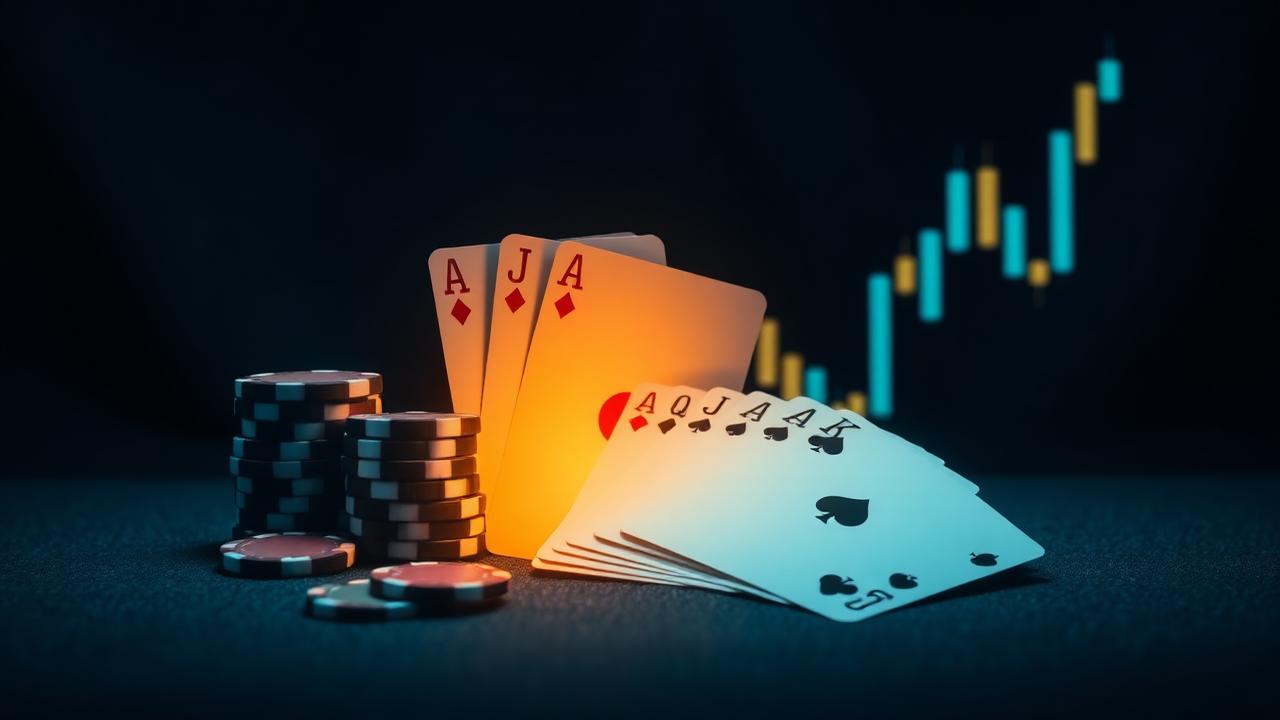
"Trading is just poker with better graphics" — a half-joke that's lived in the trading community for decades. Legendary traders like David Einhorn, Vanessa Selbst, and Aaron Brown all came from the poker tables. But is this comparison just a catchy metaphor, or does it hold real substance? This article explores both the deep similarities and the critical differences between the two disciplines.
1. The core similarities
Both are games of imperfect probability
In poker, you never know your opponent's cards. In trading, you never know the next price. Both force players to make decisions under uncertainty, based on incomplete information. This is the fundamental contrast with chess — where every piece of information is on the board.
Expected Value (EV) is the compass
A great poker player doesn't care about winning a single hand — they care: "if I make this decision 1,000 times, is the average EV positive or negative?" Same with great traders — a losing trade doesn't mean a bad decision, as long as the setup has positive edge over many repetitions.
Both poker players and traders must learn a hard lesson: good decisions can produce bad outcomes, and bad decisions can produce good outcomes in the short run.
Bankroll management = risk management
Poker has "bankroll management" — never sit at a table with more than 5% of your roll. Trading has "position sizing" — never risk more than 1–2% per trade. The philosophy is identical: protect capital so you can keep playing.
Tilt — the common enemy
In poker, "tilt" is losing your cool after a bad beat and making emotional decisions. In trading, it's "revenge trading" — averaging down or doubling up after a loss. Both destroy bankrolls faster than any skill deficit.
Reading "ranges" instead of guessing exact
Strong poker players don't try to pinpoint an opponent's exact two cards — they assign a range of possible hands and probabilities. Strong traders don't try to predict tomorrow's exact price — they build scenarios (bullish/bearish/range) with probabilities, then enter where R:R is best.
2. The critical differences
Player count and opponents
Poker is a zero-sum game with a defined number of players — your winnings come directly from opponents' pockets. Trading is more complex: millions participate, capital comes from many sources (hedgers, market makers, retail, large funds), and sometimes it's not zero-sum at all (stocks rise long-term with economic growth).
Ability to read opponents
Poker lets you watch behavior, betting patterns, and body language of specific opponents. Traders can only read "crowd psychology" through price action, volume, and order flow — far more indirect and ambiguous.
Hand count and feedback loop
A poker pro might play 50,000–100,000 hands a year — large enough for probability to converge to true value. A swing trader may only take 100–300 trades a year. That makes edge evaluation in trading much harder — small samples easily produce illusions.
News and macro events
Poker is a closed environment — just cards and opponents. Trading is open — a single central bank tweet can flip every technical analysis upside down. Traders face fundamental risk that poker players never deal with.
Leverage and unlimited volatility
In poker, you can't lose more than the chips you bring. In leveraged trading, a price gap can push your account negative — you owe the broker money. Tail risk in trading is far larger.
3. Lessons from poker every trader should adopt
- Separate decisions from outcomes: evaluate trades by process, not P&L.
- Log every hand/trade: poker pros review hand histories; traders need a detailed journal.
- Table selection: pros only sit at soft tables. Traders only take A+ setups, skip the rest.
- Separate bankroll: never mix living expenses with trading capital.
- "Next hand" mindset: the last hand is done — don't let it bleed into the next.
4. Where the analogy breaks
A common mistake is thinking trading is just poker. Trading also demands: macro understanding, reading reports, leverage management, understanding spread/commission/swap structure, and handling weeks of "no setup" — none of which exist in poker. You can't "fold" out of a losing portfolio; you must actively exit or hedge.
5. So is trading like poker?
Verdict: similar in mindset, different in mechanics. On decision-making under uncertainty, bankroll management, emotional control, and EV thinking — trading and poker are twins. On market structure, participant count, macro impact, and tail risk — they're entirely different beasts.
Conclusion
If you're serious about trading, spend a few hours with "The Mental Game of Poker" by Jared Tendler or "Thinking in Bets" by Annie Duke. The lessons in probabilistic thinking, emotional management, and decision discipline from poker will transform how you view every trade. The best traders aren't the best predictors — they're the most consistent decision-makers under uncertainty. And that is the spirit of a professional poker player.